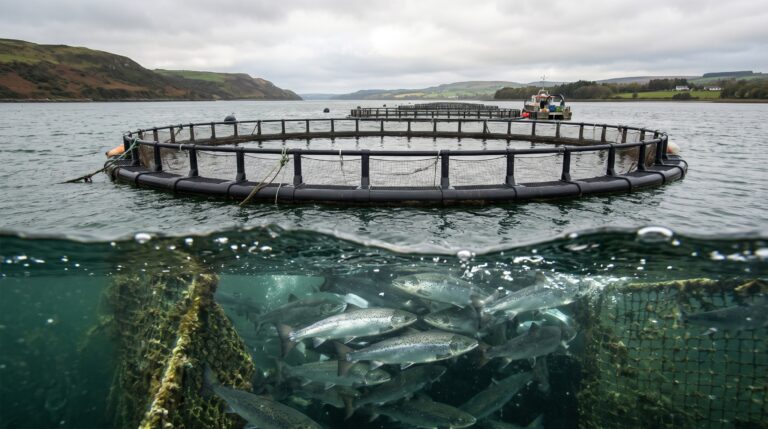
A delegation from the Foyle Association of Salmon and Trout Anglers (FASTA) has addressed Stormont’s Agriculture, Environment and Rural Affairs (AERA) Committee, issuing an urgent warning regarding proposed fisheries legislation that could open the door to industrial fish farming in local waters.
Representing anglers across the Foyle system and its tributaries, FASTA raised strong objections to provisions in the proposed Fisheries, Aquaculture and Water Environment Bill that could permit offshore or estuarine salmon cage farming.
The Threat to Migrating Stocks
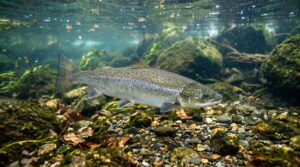
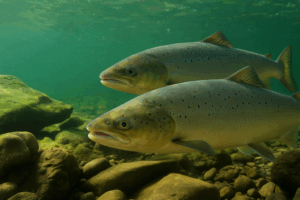
FASTA member Brendan Winters (Sion Mills) presented the committee with alarming figures regarding the long-term decline of wild Atlantic salmon, highlighting how cage aquaculture could deliver a fatal blow to remaining stocks:
“Over the past 40 years, we have seen a huge decline in the percentage of salmon smolts that return to our rivers. It has gone from 30 per cent to as little as 2 per cent.
If the go-ahead is given for salmon cages to be reintroduced in our estuaries, or close to where the estuaries go into the sea, the worry is that parasites, sea lice and other pathogens that may result from the industrialised process of fish farming will have an effect on migrating salmon smolts going outwards and fish returning to our rivers.”
Mr Winters stressed that juvenile smolts leaving the rivers are uniquely vulnerable, and heavy sea lice burdens originating from concentrated cage pens dramatically accelerate mortality before fish can ever reach their ocean feeding grounds.
Learning from the Scottish Experience
FASTA Secretary David Nelson called on legislators to scrutinise the wider international record of open-net salmon farming, citing Scotland’s experience as a clear cautionary tale:
“We have concerns about offshore salmon cage farms: as a group, we strongly object to the Bill’s opening the door to that business model.
The Scottish model is an example of significant failure and threats to the ecosystem. We demand that, if something were to occur on the blind side, there would be robust application processes and a proper, proportionate balance struck between real gain and real community loss relating to salmon farming.”
Future-Proofing Local River Protection
In addition to aquaculture concerns, the FASTA delegation pressed the committee on persistent river pollution incidents and the ongoing destruction of critical spawning gravels.
FASTA member Colin Duncan delivered a blunt assessment on riverbed protection:
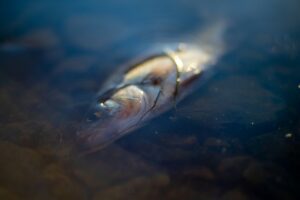
“We have to protect the spawning beds of the Atlantic salmon before it becomes an extinct species.”
Summarising the association’s position, Mr Nelson urged Stormont to ensure any new statutory framework looks far into the future:
“The current Fisheries Act dates back to the 1950s. These matters have been entirely overlooked for too long. Any new legislative improvements have to be thoroughly thought through and future-proofed for decades to take account of where we are going with threats to our natural environment.”
FASTA will continue to monitor the progress of the Bill closely and engage with elected representatives to safeguard wild salmon, sea trout, and the entire Foyle river basin.
The full news report can also be read on the Derry Journal website.